cd .. # all posts
At 30,000 merges a day, who decides what merges?
Six pre-registered experiments behind mergeone, an open-source merge gateway for repositories where agents write most of the commits. Three failed. All six are here.
Two posts from Anthropic framed the problem for me this month. On 13 October their engineering team described rebuilding source control around agents: in May they merged about 2,500 code changes a day; by September it was over 30,000, and the bottleneck had moved from writing code to everything built for human scale around it. Two days later the Claude Code team described how they review code at that volume: seven layers in front of trunk, a classifier — not the author — setting each change’s risk tier, most PRs merging with at most one human in the loop.
 anthropic.com/engineering · 13 Oct 2026
Redesigning source control at Anthropic
"As our merges per day grew more than tenfold, source control became our biggest development bottleneck." 2,500 merges a day in May, 30,000+ in September.
Read the post →
 claude.dev/blog · 15 Oct 2026
How the Claude Code team does code review
Seven layers in front of trunk, a classifier setting each change's risk tier, at most one human per PR; reverts down 40%.
Read the post →
I had been building towards the same question since the beginning of the month, as an experiment rather than a product: when a human cannot read every merge, what is the smallest, fastest thing that can make the decision, and how do you know whether it is any good? The answer I ended up with is mergeone, an open-source merge gateway, and gatebench, the pre-registered benchmark that decides what it is allowed to claim. This is the long version of both.
The shape of the gate
A frontier model is the obvious thing to put in front of trunk, and the wrong one. It is slow (seconds per PR), expensive at 30,000 a day, and it answers in prose, which cannot be put behind a rule. What I wanted was a typed decision: a fixed set of questions about a pull request, each answered with a calibrated probability, in one call fast enough to sit inside an agent’s loop.
PR opened ─▶ render once ─▶ decision model ─▶ calibrate ─▶ .mergeone.yaml ─▶ pass | hold | block
             diff + message   ~5 typed questions  isotonic     rules, first      auto-merge | human | stop
             + PR memory      one call, ~300 ms   0.6 = 60%    match wins
                                       └─▶ gatelog: every verdict, its input, its hash
The questions are things like is_logic_change, weakens_tests, message_matches_diff, touches_concurrency, needs_human_review, and — when PR memory is on — duplicate_of an open PR. The model never sees a rule and never writes prose. A policy file the repository owns turns probabilities into a verdict; rules run top to bottom; a model outage holds the PR for a human. The whole thing is one Go binary that runs as a CI step, a GitHub webhook, or an MCP tool an agent calls before it merges. In MCP mode it never writes to GitHub; in webhook mode it can set a commit status, a label and one comment per head SHA, and never merges anything itself.
The models answering the questions are System One models: small decision models exposed through a /v1/systemone-style API, hosted or self-hosted, that return probabilities for a batch of typed questions in a few hundred milliseconds. Which one is a config line.
The rule that makes it a study
Before any model was called, I wrote down every hypothesis and every threshold in PROTOCOL.md and committed it. Every deviation after that is dated in a changelog with its reason. Metric thresholds are never edited once results exist. Results are published whichever way they fall — and three of six runs fell the wrong way. This is the part I would keep if I lost everything else: it turns “my gate works” into a sentence with a number, a bar and a date attached, and it is the reason the negative results below exist at all.
Six runs
Run 1 — negative. Can a diff predict a 30-day revert? 40,000 Kubernetes merges. Rules, a gradient-boosted model, a frontier LLM used as a judge and a System One model all land at PR-AUC ≈ 0.010 against a base rate of 0.0075 — chance, within confidence intervals of each other. The signal is not in the diff. I did not build a product on it.
Run 2 — positive. Can a System One model answer typed triage questions? Five questions, one call, 347 ms, $0.074 per thousand PRs. ROC-AUC 0.87–0.96 against a strong LLM judge, with isotonic calibration taking expected calibration error from 0.17 to 0.03. The bar was met on 5 of 5 questions by the hosted model and 4 of 5 by the LLM judge used as a decision model. Honest limit: the ground truth here is a model’s judgement audited for self-consistency, not a hand label.
Run 3 — negative. Does the gate predict rejection of real agent PRs? 2,196 pull requests opened by coding agents across 26 public repositories, 705 held out from 8 repositories never seen in fitting. Calibrated needs_human_review against closed unmerged or changes requested: ROC-AUC 0.55, bar 0.70. The reason is in the labels. Of 200 closures I classified by hand, 67% were superseded, duplicate or direction and only 19% quality. A diff cannot tell you that someone else already landed the fix. Two things did hold: the hosted model at 100× agent-scale load answered every call at p99 417 ms, and, exploratory only, the questions tracked how much review iteration a PR would go through.
Run 4 — mixed. Can a per-repository PR memory catch the duplicates? Half of it. Given a candidate pair, the typed question same_change(A, B) separates maintainer-confirmed supersedes from the rest at ROC-AUC 0.83–0.87 for three System One models on held-out repositories, above the 0.80 bar, at under half a second and under $0.0005 per PR. The LLM judge scores 0.76 and fails. But the retrieval that proposes the candidates finds only 55% of the gold duplicates in its top five (bar 0.60), so at the verdict level the dedup rule moves the pass group’s bad-outcome rate from 0.41 to 0.36 against a bar of 0.23. Four of five hypotheses fail; the one that passes is the one I was least sure of. Memory ships opt-in.
Run 5 — mixed. Does a flag mean more review? Run 3’s exploratory finding became a pre-registered one: calibrated needs_human_review predicts whether an agent PR goes through two or more force-push rounds at AUC 0.76 for two models (bar 0.70). Retrieval v2 lifted recall@5 from 0.55 to 0.66, still short of 0.70; the Go store answers in 3.3 ms p99. The ten-question stack missed its bar because the pruning rule, chosen on validation exactly as pre-registered, dropped hard_to_revert, which turned out to be the strongest single question on test. Declared assumptions could not be judged: maintainers wrote a “depends on / conflicts with” note on 9 of 2,196 PRs. And both hosted open-weight models held p99 flat from 1× to 100× and then lost 71% of calls to HTTP 429 — a per-organisation rate limit of ten requests per second.
Run 6A — negative. Do self-hosted open weights clear the scale bar? The weights behind the 4B model are Apache-2.0, so I served them myself with the vendor’s own inference code, no quantisation, on rented GPUs. On one L4 ($0.59/h) the model agrees with the hosted endpoint on 95.2% of answers but not within the 0.02 mean |Δp| bar (0.047), so by the protocol it is a different model; its quality is a confidence interval away (AUC 0.747 vs 0.758); the model card’s “one question per request” advice gains +0.000 AUC for ten times the calls; and the server saturates at about 2.2 requests per second — six times the 30,000-a-day base rate, an order of magnitude under the 100× bar. A second pass tested the obvious lever: length-aware micro-batching changed nothing on either card, because a request takes as long inside a batch as alone. One H100 ($3.99/h) carries 30× the base rate at 160 ms p99 with zero errors — faster than the hosted endpoint — and still times out 30% of calls at 100×. $0.106 per thousand PRs at that rate, 4.6× the hosted list price. Total GPU bill for all of it: about six dollars.
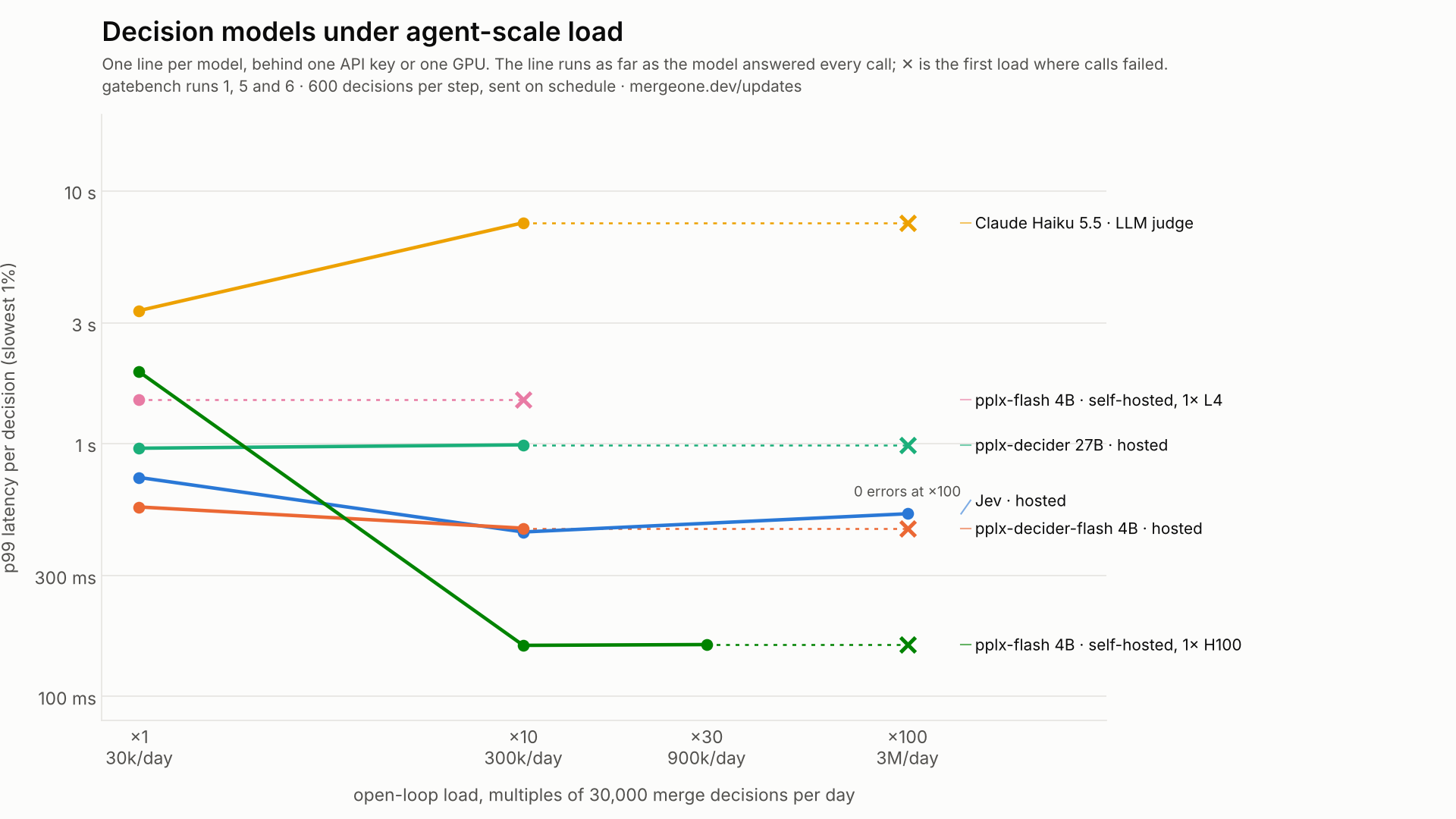
One line per model behind one API key or one GPU. The line runs as far as every call was answered; ✕ is the first load with failures. Only the hosted System One model reaches 100× — three million decisions a day — clean; one H100 is the fastest row and stops at 30×.
What survives, what doesn’t
What survives: typed triage of what a change does, at the speed and cost of a spellcheck; a gateway that is never the bottleneck (350 decisions a second on a two-vCPU box with a stand-in model, re-proved by CI on every push); and a cheap model that can tell whether two PRs are the same change.
What doesn’t: predicting what a project will accept from one diff, and — so far — finding the right PR to compare against. Most rejections of agent PRs are coordination, not quality, and coordination is only visible across PRs. That is why PR memory exists, why it is still opt-in, and why the next measurement is the one that matters most.
Where it sits in a stack like theirs
The code-review post stacks seven layers in front of trunk. The fifth is a classifier deciding how many humans a change needs. mergeone is that layer as a typed, calibrated, logged call with a policy on top — arrived at independently, which is reassuring. Two things from the post went straight into the gateway: a max_rounds convergence cap, because agent authors and automated reviewers can loop (one of their PRs went fifty rounds before a three-round cap), and the rule that any prompt change in the next run has to hold its score on the frozen revert set before it is kept.

What the post does not cover is the case run 3 found most often: two agents landing the same change twice. That is run 6B, in progress now: of 100 PRs the gate holds as duplicates, how many does a blind human agree are? Two labellers, pre-registered bar, Cohen’s κ reported, disagreements adjudicated in the open. I will publish it the same way whichever way it falls.
Try it
curl -fsSL https://mergeone.dev/install.sh | sh
cd your-repo && mergeone init
mergeone pr --policy .mergeone.yaml --base origin/main --head HEAD
mergeone serve --mock runs the whole pipeline with a stand-in model if you have no key, and mergeone replay dry-runs your policy over 1,200 real PRs shipped in the repository. Protocol, raw predictions, load-test files, the GPU runbook and a dated updates page: mergeone.dev · github.com/haalp/mergeone. Apache-2.0.